

A small defence of the woman behind the role
You said it at a dinner party last spring.
Someone asked what you did, and your mouth opened, and out came the words “Oh, I’m just a mum these days,” before your brain could intervene.
You watched yourself shrink in real time.
The word just did the work. Two letters that erased twenty years. Two letters that made the woman you used to be (the one who led teams, who had opinions about systems and structure, who could hold the attention of a board room) into a footnote. Two letters that made the work you are doing right now (raising a person, sustaining a household, holding the emotional architecture of a family together) sound like a hobby you fell into.
You did not mean it. You said it because it was the smallest, lightest version of yourself to offer a near-stranger at a dinner party. But it landed. You felt it. The other people at the table moved on quickly, and you stayed in the moment for a beat longer than they did, asking yourself when just became the word you reached for first.
This essay is for the woman who is figuring out how to be a mother and a person at the same time, without the just.
The lie that runs the show
The lie is not that motherhood is incompatible with the rest of you. Most women know that is not quite true. The lie is more subtle. It is the one that says: the wanting itself is the problem.
That when you want a quiet morning, a working life, a body that is yours, a Saturday that does not belong to anyone else, a conversation that does not end with someone shouting your name from the other end of the house, the wanting is the failure. That a good mother does not want these things. That if you wanted them less, you would be more whole.
The lie has a softer cousin who says: you will have time later. Later, when they are in school. Later, when they are older. Later, when they go to college. Later, when they leave home. Later, when the demands lessen. Later, eventually, someday.
However, later is a country that does not exist. It is a story we tell ourselves so we do not have to negotiate with the present. The version of you that is waiting in ‘Later‘ is a fiction. She does not have a body, a calendar, or a list of things she will do once she is given permission. She is a comfort. A way of postponing the harder work of becoming the woman you want to be while small humans still need their socks found.
The third cancellation
You noticed it on a Tuesday.
You opened the calendar and saw that you had cancelled a catch-up with a friend for the third time in a month. The first time was because someone had a fever. The second time was a school play. The third time was because the day had been too long and you could not face the version of yourself who would have to put on a different jumper and have opinions about a book you read in fragments.
You sat with the calendar open and felt something you had been outrunning. The catch-up was the small thing. The small thing was not the small thing. The small thing was you, repeatedly choosing to disappear from your own life because disappearing was easier than insisting on yourself.
This is the way it happens. It does not happen in a single moment. Instead, it happens in the slow accumulation of cancellations, small disappearances, choices that look reasonable in isolation and read, in retrospect, as a pattern.
The danger is not that you cancel meeting a friend.
The danger is that you stop noticing.
What it actually looks like, the resurfacing
You started small. Smaller than you would have thought you needed to.
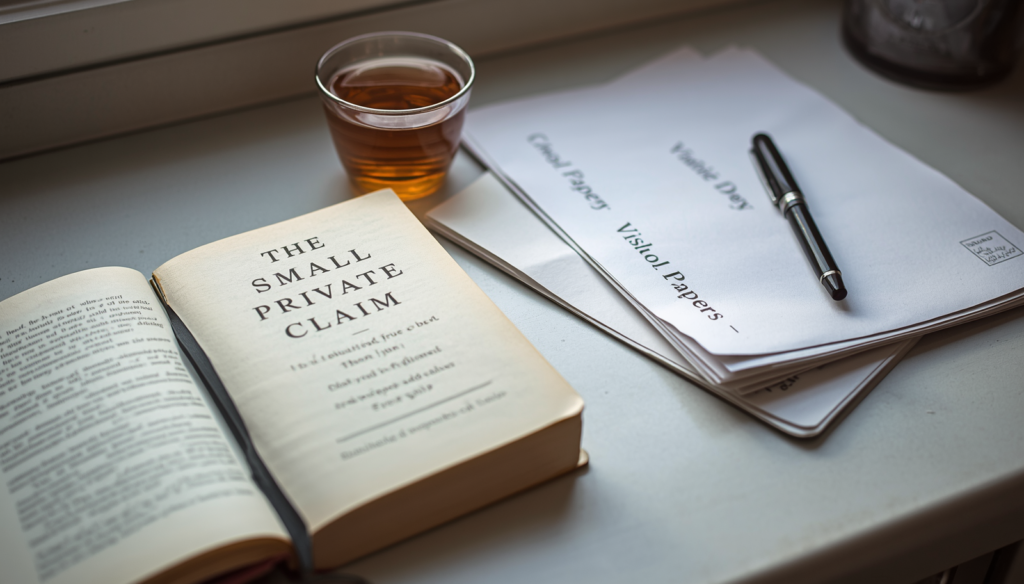
You took the school run as a window. You started keeping a book in the car. Not to read while driving. To read in the ten minutes you sit in the car park before walking in. Ten minutes is not enough to read a chapter. However, ten minutes is enough to remember you have a mind.
You started leaving the house when the day cracked. Not for long. Not far. You learned to walk out when the going got hard. To say “I am going to clear my head for fifteen minutes,” and to go, and to come back. The problems wait for you. They almost always wait for you. They are usually still there, sometimes slightly bigger, but they are not solved by your sitting on top of them either. The walking out turned out to be an investment in coming back as a person who could actually handle the thing she walked out from.
You stopped saying just. That took longer than the rest. The word had grooves in your mouth from years of use. You replaced it with the truth, which is harder to say but cleaner to live with. “I am a mother. I also write. I also work. I also sit on a bench in the afternoons sometimes, just to think.”
You joined the book club. Not every time. But enough times that your name appeared on the next month’s poll.
The poll asking what you wanted to read next.
On wanting
Wanting things for yourself is not ingratitude. Instead, it is the most fundamental act of being a whole person. Gratitude and ambition are not opposites. They live in the same body, often in the same hour, sometimes in the same breath.
You can love your children with everything you have and also want to write a book.
You can be deeply present at bedtime and also count the hours until your morning starts.
You can be exhausted by motherhood and also be the kind of mother whose children grow up with the example of a woman who did not erase herself.
The children do not need a mother who has disappeared. They need a mother who is recognisable as a person. Children learn from what we model, not from what we tell them. A daughter watching her mother say just learns that the woman behind the role is something to apologise for. A daughter watching her mother walk out for fifteen minutes to clear her head learns that an adult person attends to her own mind. She learns this even if you never say a word about it. She learns it because she sees it.
To the woman watching all of this
If you are not a mother and you are reading this because you have watched the women around you disappear into their motherhood and you are afraid of doing the same, I want you to know something specific.
The disappearing is not motherhood. The disappearing is the lie. The lie that wanting anything for yourself is ingratitude. That lie operates on women regardless of whether they have children. It just gets a sharper edge when there are small humans involved, because the sharpness is socially sanctioned.
What you should be afraid of is not motherhood. What you should be afraid of is the version of any role (mother, wife, daughter, employee, friend) that asks you to subtract yourself in exchange for being needed.
The women who do not disappear are the ones who refused, on small Mondays, to keep cancelling.
You do not need to be a mother to refuse that. You can start now.
The closing
You will not always do it well. Some weeks you will say just before you can stop yourself. Some weeks book club will be cancelled four times. Some weeks the walking out will not happen, and you will sit at the kitchen table at 9pm with your head in your hands wondering when you stopped being a person.
That is the work. The work is not getting it right. The work is noticing, again, that the pattern of disappearance has crept back in, and choosing, again, to insist on yourself.
You are a mother.
You are also a person.
Both. At the same time. Without apology. Without permission. Without the just.
If this landed, you might also like:
The Art of Beginning Again When You Thought You Were Halfway There
What I Stopped Tolerating, and How My Life Changed (Coming Soon)
Sources and further reading
The concept of motherhood as identity transformation (matrescence) was reintroduced into modern psychology by Aurélie Athan at Columbia. Her work is the foundational reference for the idea that becoming a mother is itself an identity stage, not a side-effect of one: https://www.matrescence.com/
On the cognitive labour of running a household and the invisible work that falls disproportionately on mothers, Allison Daminger’s research at Harvard is the canonical citation: https://journals.sagepub.com/doi/10.1177/0003122419859007